 how-to
How to Vacate a Default Judgment for Debt
Table of Contents
- What It Means to Vacate or Set Aside a Default Judgment
- Grounds to Vacate a Default Judgment
- Deadlines and Filing Requirements for Your Motion
- How to Prepare and File a Motion to Vacate Default Judgment
- Essential Documents and Evidence Checklist
- What Happens After a Motion to Vacate Is Filed
- How Long to Vacate a Default Judgment and Timeline Expectations
- Common Mistakes to Avoid When Filing Your Motion
- Frequently Asked Questions
Last Updated: October 19, 2026
What It Means to Vacate or Set Aside a Default Judgment
Vacating a default judgment means asking the court to cancel a judgment entered against you because you failed to respond to a debt lawsuit, and understanding how to vacate a default judgment for debt is your first step toward reclaiming your legal rights. When you don't answer a summons or appear in court, the judge can enter a default judgment automatically.
Setting aside a default judgment is your legal right to challenge that order. It's not an admission that you don't owe the debt, it's a request to get back into the case and defend yourself. Once vacated, the lawsuit returns to square one.
A default judgment has serious consequences: creditors can garnish your wages, freeze your bank accounts, or place liens on your property, and it damages your credit report for seven years. At WageHelpCenter, we provide educational resources to help individuals understand that vacating a judgment is often possible, even if you missed the deadline.
Learning how to vacate a default judgment for debt requires filing a motion with the court, explaining why you missed the deadline and showing a valid defense. If granted, you get a second chance to fight the debt in court.
Grounds to Vacate a Default Judgment
Courts allow you to vacate a judgment for specific legal reasons, and these grounds determine whether your motion will succeed.
Lack of proper service is one of the strongest grounds. If the creditor didn't serve you correctly with the summons and complaint, the court never had jurisdiction over you. Service must follow strict rules, in person or at your home with someone of suitable age and discretion.
Excusable neglect is the most common ground. This means you had a good reason for missing the court deadline. Examples include:
- Serious illness or medical emergency
- Death of a family member
- Unexpected job loss or financial crisis
- Confusion about court procedures
- Language barriers or disability
The key is showing you acted reasonably despite the circumstances. You can't simply say you forgot, explain what happened and why a reasonable person would have missed the deadline too.
Meritorious defense strengthens your motion significantly. This means you have a legitimate reason to dispute the debt. Common defenses include:
- The debt is outside the statute of limitations
- You already paid the debt
- The amount claimed is incorrect
- The creditor lacks proper documentation
- Identity theft or fraud
- Improper billing practices
A meritorious defense tells the judge that even if you had responded on time, you might have won.
Mistake, inadvertence, or surprise can also support your motion, for example, a court date you didn't understand or papers you thought gave you more time.
Deadlines and Filing Requirements for Your Motion
Timing is everything when filing a motion to vacate. Missing deadlines can permanently close your options.
Federal courts have a strict 30-day deadline: file your motion within 30 days after learning about the default judgment. Once it passes, federal courts rarely grant relief.
State courts vary significantly. Some follow a 30-day rule similar to federal courts; others allow 60 days or a year, and a few vary by case type or amount. Check your state's rules.
When does the clock start? The deadline typically begins when you receive notice of the default judgment, from the creditor or the court. Record when you first learned about it.
How to file your motion depends on your court. Most courts require:
- A written motion to vacate signed by you or your attorney
- An affidavit explaining why you missed the deadline
- Evidence supporting your excuse
- Proof that you served a copy on the creditor's attorney
File with the court clerk, pay the filing fee or request a waiver, keep copies, and ask the clerk for exact procedures.
Fee waivers are available if you qualify. File an affidavit of indigency explaining your financial situation; if approved, you won't pay filing fees. WageHelpCenter's guides explain how to complete this form correctly.
How to Prepare and File a Motion to Vacate Default Judgment
Preparing a strong motion takes organization and clear writing. The better your motion, the more likely the judge will grant it.
Step 2: Write your affidavit. An affidavit is a sworn statement describing what happened and why you missed the deadline. Be honest and specific, vague explanations hurt your case.
Step 3: Draft your motion. Keep it clear and concise: state the case number, the default judgment date, and the specific grounds you're relying on.
Step 4: Serve the creditor. Give a copy of your motion to the creditor's attorney by mail, email, or hand delivery, depending on your court's rules.
Step 5: File with the court. Submit your motion and all attachments to the court clerk. Pay the filing fee or submit your fee waiver request. Keep a copy for yourself.
Step 6: Prepare for the hearing. The judge will likely schedule a hearing where you explain your situation in person. Practice what you'll say, bring additional evidence, dress professionally, and be respectful.
Essential Documents and Evidence Checklist
Success depends on having the right documents. Use this checklist to ensure you're not missing anything.
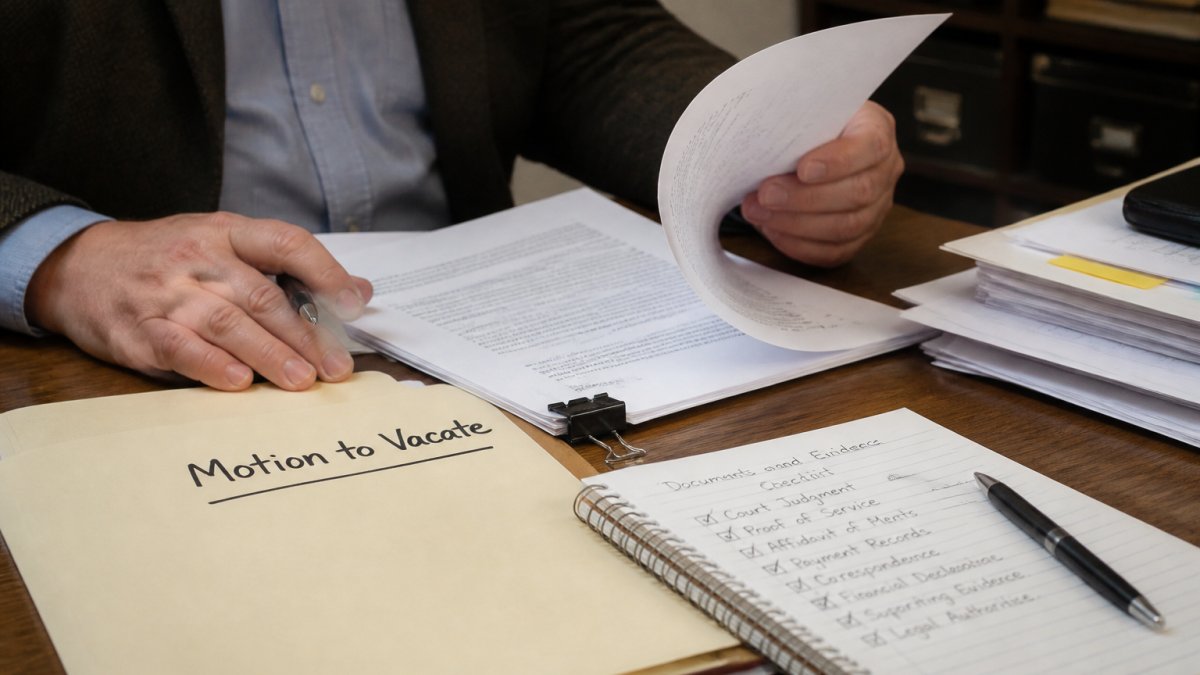
Required documents:
- Original summons and complaint (the papers that started the lawsuit)
- Notice of default judgment (the order saying you lost)
- Proof of service (showing how you were served)
- Your motion to vacate (the formal request to the court)
- Your affidavit (your sworn explanation)
- Proof of service on the creditor (showing you gave them a copy)
Supporting evidence for your excuse:
- Medical records if you claim illness
- Death certificate if a family member died
- Job termination letter if you lost employment
- Proof of address change if you moved
- Letters from witnesses who can confirm your situation
- Photos or documents showing what happened
Evidence of meritorious defense:
- Payment records showing you paid the debt
- Receipts or bank statements
- Correspondence with the creditor
- Proof the debt is outside the statute of limitations
- Evidence of identity theft or fraud
- Documentation of billing errors
Evidence of improper service:
- Affidavit stating you never received the papers
- Proof you lived elsewhere at the time
- Witness statements from people who lived with you
- Records showing you weren't home during service attempts
Organize these documents in a clear folder, number them, create an index, and make copies for the judge, the creditor, and yourself. Courts appreciate organization.
What Happens After a Motion to Vacate Is Filed
After you file your motion, the case enters a new phase. Knowing what comes next helps you prepare.
The creditor responds. The creditor's attorney will likely file a response opposing your motion, arguing you had proper notice, your excuse isn't valid, or you lack a meritorious defense. This typically comes within 10-20 days.
The judge reviews everything. The judge reads your motion, affidavit, the creditor's response, and all supporting documents. Filing alone doesn't win, the judge must believe you had a good reason for missing the deadline and a legitimate defense.
A hearing is scheduled. Most courts hold a hearing where you explain your situation in person, answer questions, and present additional evidence. The judge then decides whether to grant or deny your motion.
The judge rules. The judge will either grant your motion to vacate (the judgment is canceled) or deny it (the judgment stays).
Collection activity may continue. Even while your motion is pending, the creditor might attempt wage garnishment or bank account levies. Some courts pause collection while the motion is pending; others don't.
How Long to Vacate a Default Judgment and Timeline Expectations
The time it takes to vacate a default judgment varies based on several factors.
Filing to hearing: 4-8 weeks. The court typically schedules a hearing within 4-8 weeks of filing, giving the creditor time to respond and the judge time to review the papers.
The hearing itself: 15-30 minutes. Most hearings are brief: the judge asks questions, you and the creditor's attorney speak, and the judge either rules immediately or takes the case under advisement.
Decision after hearing: immediate to 30 days. Some judges rule from the bench right after the hearing. Others take the case under advisement and issue a written decision within 2-4 weeks.
Total timeline: 6-12 weeks from filing to decision. Most cases get an answer within three months. If the judge denies your motion and you appeal, expect 6-12 months or more.
Expedited relief. If you face immediate wage garnishment or other urgent collection action, some courts allow expedited motions.
After the decision. If your motion is granted, the judgment is vacated immediately. You then have a set amount of time (usually 20-30 days) to file an answer to the original complaint.
Common Mistakes to Avoid When Filing Your Motion
Many people hurt their own cases with preventable errors. Knowing what to avoid increases your chances of success.
Missing the deadline. This is the most critical mistake, once it passes, most courts won't hear your motion.
Weak excuses. "I didn't know about the court date" or "I was too busy" won't work.
No meritorious defense. If your only argument is that you missed the deadline, you're less likely to win.
Poor documentation. Don't rely on your memory. Keep receipts, letters, and records, courts trust documents more than spoken words.
Sloppy paperwork. Courts have strict formatting and filing rules.
Failing to serve the creditor. You must give the creditor a copy of your motion.
Not showing up to the hearing. If the judge schedules a hearing and you don't appear, your motion will be denied.
Lying or exaggerating. Never lie to the court, judges can tell, and exaggerating weakens your credibility.
Ignoring the creditor's response. When the creditor files a response, read it carefully. Understand their arguments.
Not requesting a fee waiver. If you can't afford the filing fee, request a waiver.
Facing a default judgment for debt feels overwhelming, but you have legal options.
Frequently Asked Questions
What are valid reasons to ask a court to vacate a debt judgment?
Courts may vacate a default judgment if you were never properly served with the summons and complaint, if you had a reasonable excuse for missing the court date, or if you have a meritorious defense to the debt claim itself. Reasonable excuses include serious illness, family emergency, or lack of actual notice despite proper service procedures. A meritorious defense might be that the debt was already paid, the amount is incorrect, or the statute of limitations has expired. The specific grounds vary by state, so check your local court rules.
How long does it take to vacate a default judgment?
The timeline depends on your state's rules and court schedule. The timeframe for filing a motion to vacate varies by state, with some allowing filings within 30 days after the judgment is entered, while others extend this to one year or longer. After you file, the court typically schedules a hearing within 2-6 weeks. If the judge grants your motion, the judgment is vacated immediately. If denied, you may have appeal options. Contact your local court clerk for specific timelines in your jurisdiction.
What documents do you need to file a motion to vacate a default judgment?
You need the notice of motion, a declaration or affidavit explaining your reasonable excuse for the default, proof that you served the opposing party with copies of your motion, and any supporting evidence (medical records, proof of improper service, payment receipts, or correspondence showing the debt dispute). Some states require a proposed order for the judge to sign. Check your court's website for the specific form requirements and filing fees, which vary by jurisdiction.
Can you challenge a default judgment if you were never served?
Yes. Improper service is one of the strongest grounds to vacate a default judgment. If the creditor or debt collector failed to properly serve you with the summons and complaint according to your state's rules, the court lacked jurisdiction over you and the judgment is invalid. Gather evidence such as affidavits stating you never received the papers, witness statements, or proof that the service address was incorrect. This defense often succeeds because courts cannot enforce judgments against defendants who had no actual notice of the lawsuit.