 how-to
How to Identify a Fake Debt Collection Summons
Table of Contents
- Why Fake Debt Collection Summons Are a Growing Threat
- Red Flags That Signal a Fake Summons
- How to Verify a Debt Lawsuit Through Court Records
- Understanding the Fake Court Summons Scam
- How to Verify Your Debt and Collector Identity
- What to Do When You Receive a Summons
- Understanding Real Court Summons vs. Collector Demand Letters
- Missing a Real Summons Deadline: Consequences and Recovery Options
- Frequently Asked Questions
Last Updated: October 17, 2026
Why Fake Debt Collection Summons Are a Growing Threat
Scammers are getting better at impersonating courts and debt collectors, and a fake debt collection summons looks real enough to fool most people.
This guide covers warning signs, verification steps, and what to do with a suspicious summons.
The real danger isn't just losing money.
Legitimate courts follow strict rules about how they contact you; scammers break those rules constantly. Learning the difference could save you thousands.
Red Flags That Signal a Fake Summons
Not every suspicious-looking document is fake, but certain warning signs almost always point to a scam.
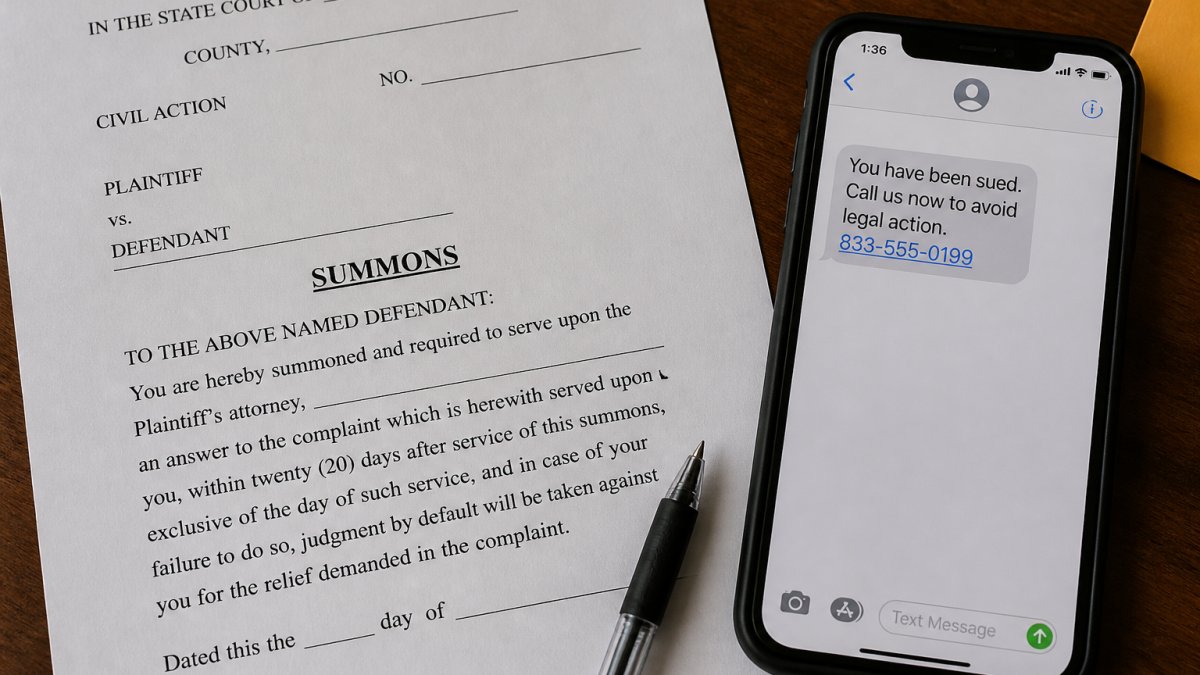
Suspicious Contact Methods
Real courts don't contact people by text, email, or social media. They use certified mail or a process server.
Scammers rush you, demanding immediate response or arrest. Real courts give you time to respond, typically 20 to 30 days.
Scammers also provide a phone number or website to "verify" the case or pay.
Unusual Payment Demands
Legitimate debt collectors and courts never ask for wire transfers, prepaid cards, or gift cards.
Real collectors may offer payment plans, but courts don't collect payments directly, they issue judgments that creditors enforce through legal channels.
Demands for "immediate payment" to avoid arrest or account closure are a strong scam indicator, courts don't threaten arrest for unpaid debt in most situations.
Threatening Language and Tactics
Scammers weaponize fear, threatening arrest, jail time, account closure, license suspension, or wage garnishment if you don't pay right now.
Real court documents are formal but not threatening, they explain your rights and options rather than using language designed to panic you.
Spelling errors, poor grammar, or unusual formatting are suspicious; court documents are prepared by legal professionals and follow standard formats.
How to Verify a Debt Lawsuit Through Court Records
Verifying a summons is not the same as verifying a debt. A debt can be real while the summons is fake, and a summons can be real even when the debt isn't yours. The only way to separate the two is to independently confirm that a case actually exists in the court that supposedly issued the paper.
Work through this checklist in order, and don't skip a step because the document looks official.
Summons Verification Checklist
- Identify the court named on the document. Write down the exact court name, county, and any division (e.g., small claims or civil). A real summons names a court that exists and has authority over you.
- Find that court's official contact information yourself. Do not use any phone number, website, QR code, or email printed on the summons. Search for the court by its official name and confirm the address and phone number match the court's own site or the state judiciary's directory.
- Ask the clerk whether a case exists in your name. Call the clerk's office using the number you found independently. Give your full legal name and, if listed, the case number. Ask: "Has a case been filed against me, and am I listed as a defendant?"
- Confirm the case number format. Case numbers follow court-specific patterns (year, case type, sequence). A clerk can tell you within seconds whether the number on your document fits the court's format, a mismatch is a strong sign of a fake.
- Confirm the parties. The plaintiff should be a real entity, often the original creditor or a debt buyer, and you should be named as the defendant. Ask the clerk to read back the plaintiff's name exactly as filed.
- Confirm the filing date and current status. A real case has a filing date and a docket history. Ask when it was filed and its current status (open, served, judgment entered, dismissed).
- Confirm service. Ask the clerk whether the court's records show that you were served, when, and by what method. If there's no record of service, either the summons is fake or service isn't complete.
- Confirm the response deadline. Ask the clerk what your deadline is to file an answer and how the court calculates it. Deadlines vary by jurisdiction and method of service, so get the date from the court, not the document.
If the Court Has No Online Records
Many courts, especially in less-populated counties, justice-of-the-peace courts, and small claims divisions, don't post case information online, so a failed search is not proof a summons is fake. Call the clerk directly and ask the checklist questions. If no case turns up, ask whether the court uses a different name or division than the document shows, or whether the case was filed in a neighboring court.
Find your state court's official directory of courts and case-search portals
What the Search Cannot Tell You
A confirmed case proves the lawsuit is real, not that the debt is valid, the amount correct, or the plaintiff entitled to collect, those are separate questions you raise in your answer and through debt validation. Likewise, a flawless-looking document can still be a scam if no case exists in the court's records; appearance alone never proves authenticity.
Understanding the Fake Court Summons Scam
The fake court summons scam exploits fear and urgency. Scammers know debt makes people anxious, so they send an official-looking document demanding immediate action.
Most people either panic and pay or ignore it entirely, and scammers count on both reactions, they profit from those who pay and disappear before anyone verifies the summons.
Real debt lawsuits follow a paper trail: the creditor files with the court, staff process it, and you receive official notice.
How to Verify Your Debt and Collector Identity
Even if the summons looks real and you find a case in court records, verify that the debt is legitimate and the collector is who they claim to be.
Requesting a Debt Collector Validation Notice
Under federal law, debt collectors must provide validation information when they contact you, the amount owed, the original creditor's name, and your right to dispute (Debt Collection FAQs).
If you haven't received it, send a written validation request to the collector's address and keep a copy.
The collector has 30 days to respond. If they don't provide validation or the information doesn't match what you know about your debt, the debt may be invalid.
Confirming the Collector's Credentials
Look up the collector online, their official website, the Better Business Bureau, and consumer review sites.
Scammers often use names similar to legitimate companies, "Credit Collection Services" versus the real "National Credit Collection Services." The slight difference is intentional.
Call the original creditor using a number you find yourself, not one from the summons, and ask whether they've hired that specific collector.
What to Do When You Receive a Summons
Your response depends on whether the summons is real or fake. But your first steps are the same.
Immediate Steps to Take
Stop and take a breath. Don't respond immediately, call any number in the document, or make any payments.
Write down the details:
- Court name and location
- Case number
- Creditor's name
Search the court's official records first. If no case exists, you've confirmed it's a scam.
If the case exists, call the clerk using the number from the court's official website, confirm you were properly served, and ask about your response deadline.
Using a Debt Lawsuit Answer Template
If the summons is real, file an answer, your formal response to the lawsuit, with the court by the deadline.
Your answer should:
- Admit or deny each claim in the summons
- Raise any defenses you have
- State whether you dispute the debt
Many courts post answer templates on their websites, and some offer free legal aid resources with sample answers.
Do not ignore a real summons, missing the deadline results in a default judgment, and wage garnishment or frozen bank accounts can follow.
Understanding Real Court Summons vs. Collector Demand Letters
A demand letter and a summons can look similar, both are printed, name a debt, and may mention a deadline, but they carry completely different legal weight. Confusing them is a common way people overpay a scammer or ignore a real lawsuit.
What Each Document Is
A demand letter is a private communication from a debt collector. It isn't issued or filed by a court and can't by itself take money, garnish wages, or freeze an account.
A summons is court-issued: it tells you a lawsuit has been filed, that you're the defendant, and that you must respond by a deadline.
Document-by-Document Authenticity Indicators
Use these indicators as a comparison tool, not as proof. A document can look perfect and still be fake, and a real court document can look plain.
| Element | Real court summons | Collector demand letter |
|---|---|---|
| Issuer | A named court with a court address | A collection agency or law firm |
| Case number | Assigned by the court, follows the court's format | None, or a "reference number" internal to the collector |
| Filing stamp | Often shows a clerk's filing stamp or date stamp | None |
| Plaintiff | The creditor or debt buyer, named as the party suing | The collector, often acting "on behalf of" a creditor |
| Hearing information | Names a court date, time, and location, or states the deadline to respond | No hearing; may state a payment deadline |
| Service method | Delivered by a process server or sheriff, or by certified mail where the court allows it | Ordinary mail or email |
| What it can require | A formal written answer filed with the court by a deadline | Payment, a call, or a written response to the collector |
| What it cannot do | Collect payment directly | Create a judgment, garnish wages, or freeze accounts |
What Each Document Can and Cannot Require
A demand letter can ask you to pay, call, or set up a payment plan, but it can't require a court appearance or create a judgment. A summons can require a written answer by a deadline, but it can't require payment to the plaintiff directly, courts don't collect money on the plaintiff's behalf; enforcement comes later through separate legal channels.
If a document demands immediate payment to "the court" or to a "court officer," that is a mismatch. Courts do not collect debts. Payment demands belong to collectors, and they belong after you have verified the debt and the collector.
Why the Distinction Matters for a Fake-Summons Scare
Scam warnings can push people to dismiss genuine legal papers. Don't assume a summons is fake because it arrived at an inconvenient time or you don't recognize the debt, run the verification checklist first. If a real case exists, respond by the deadline even while you dispute the debt. If no case exists, treat it as a scam and send no money or personal information.
Missing a Real Summons Deadline: Consequences and Recovery Options
Missing the deadline to respond to a real summons is one of the most costly mistakes in debt collection.
If you don't file an answer by the deadline, the court enters a default judgment against you, the creditor wins without proving their case. That judgment can lead to:
- Wage garnishment (creditor takes money directly from your paycheck)
- Bank account freezing
- Liens on property
If you've already missed the deadline, recovery is possible but harder.
Courts are sometimes sympathetic, especially if you file quickly after realizing you missed the deadline.
Facing a debt collection summons is stressful, especially when scams make it hard to know what's real.
Frequently Asked Questions
How can I tell if a debt collection summons is real?
A real summons includes specific details: the court name and address, a case number, the names of the plaintiff and defendant, the amount owed, and a clear deadline to respond (typically 20-30 days). It will be served by a process server or sheriff, not sent by text, email, or social media. Verify the summons by searching the court's online case records using the case number. Legitimate summonses come from actual courts, not from collection agencies directly. If you cannot find the case in court records, the summons is likely fake.
What should I do if I think a debt collection summons is fake?
First, verify the court and case number through the court's official website or by calling the court directly. Do not provide personal information to the number on the summons if you suspect it is fake. Request a debt collector validation notice in writing within 30 days of first contact, requiring them to prove the debt exists and that they have the right to collect it. Report the fake summons to the Federal Trade Commission (FTC) at reportfraud.ftc.gov, your state's attorney general, and local law enforcement. Keep all communications as evidence. Do not ignore a summons just because you suspect it is fake; verify it independently first.
Can a debt collector send a summons by text, email, or social media?
No. A real court summons must be served in person by a process server or sheriff, or by certified mail in some cases. Debt collectors cannot legally serve a summons through text messages, emails, social media, or phone calls. If you receive a summons through these channels, it is a scam. Legitimate debt collection notices may come by mail, but an actual court summons requires formal service of process. Always verify any summons directly with the court before taking any action or making any payments.
What happens if I miss the deadline to respond to a real summons?
If you fail to respond to a legitimate summons within the deadline (typically 20-30 days, depending on your state), the court may issue a default judgment against you. A default judgment means the plaintiff wins by default, and the court can order wage garnishment, bank account levies, or other collection actions. You may still be able to file a motion to vacate a default judgment if you have a valid reason for missing the deadline, but this requires immediate legal action. Missing a real deadline is serious; if you believe a summons is legitimate, consult with an attorney or contact your local legal aid office before the response date passes.