 how-to
How to Negotiate Debt Settlement: A Step-by-Step Guide
Table of Contents
- Assess Your Financial Situation Before Negotiating
- How to Verify a Debt Collector and Validate the Debt
- Calculate What You Can Afford to Settle
- Negotiate Debt Settlement by Phone vs. in Writing
- Creating a Debt Settlement Letter Template
- Consequences of Debt Settlement on Your Credit and Finances
- Understanding Debt Settlement Tax Implications
- Common Mistakes to Avoid When Negotiating Settlement
Last Updated: August 30, 2026
Assess Your Financial Situation Before Negotiating
Before contacting a debt collector, know exactly what you can afford to offer. Calculate your monthly income and essential expenses (rent, utilities, groceries, transportation, insurance, minimum debt payments). The gap between these is your settlement capacity.
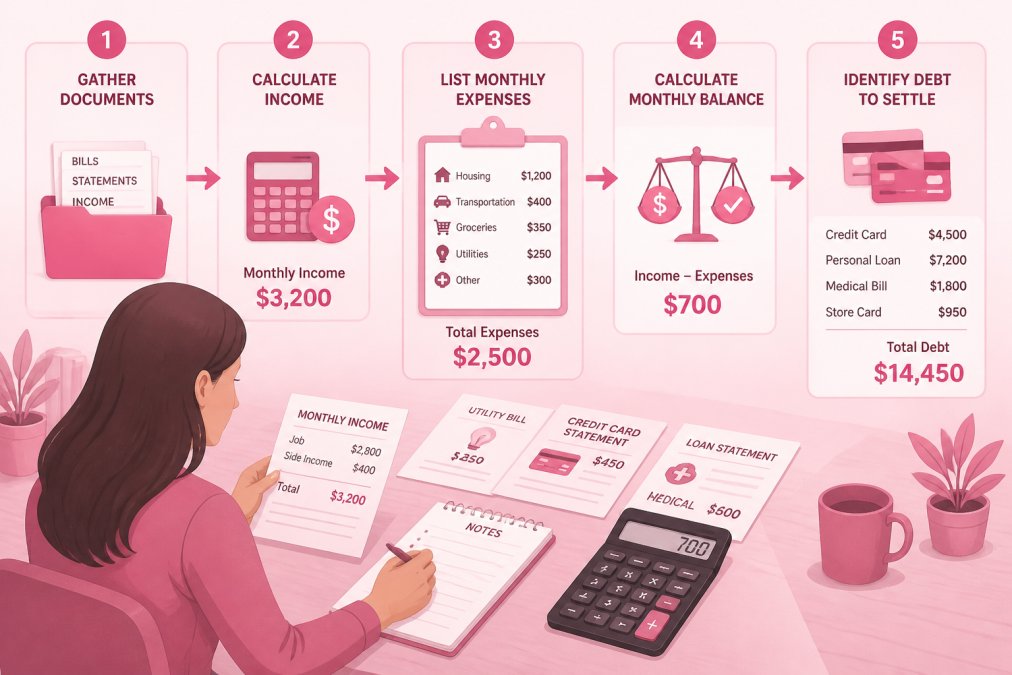
Assess your liquid assets: savings, vehicles, or family funds. Collectors are more willing to negotiate when you can pay a meaningful lump sum immediately.
Consider your employment stability and future income prospects. If job loss is imminent, settle faster before your situation deteriorates. Document any financial hardship, medical bills, job loss, disability, that justifies why settlement is better than default judgment and wage garnishment.
How to Verify a Debt Collector and Validate the Debt
Before negotiating, verify the debt is real and the collector has legal right to collect it. Under the Fair Debt Collection Practices Act, collectors must provide verification within 30 days of your request (the FTC).
Send a written debt validation letter via certified mail, return receipt requested, asking the collector to prove:
- The original creditor's name and account number
- The amount owed
- Proof the collector has the right to collect (assignment or purchase documents)
- Evidence you owe the debt (account statements, signed contract)
Many collectors cannot provide this documentation. If they can't, the debt is essentially uncollectable. Even if verified, examine it carefully. Is the amount correct? Does it belong to you? Is the statute of limitations still active? (Statutes typically range from 3 to 10 years depending on debt type and state (peer-reviewed research).)
Engaging with a collector before validating the debt is a common mistake. Once you acknowledge the debt or make a payment, you may restart the statute of limitations clock in some states.
Calculate What You Can Afford to Settle
Debt collectors typically expect to recover a percentage of the balance on unsecured debt. Older debts or charge-offs may settle for less. Your opening offer should be low enough to demonstrate serious intent but realistic enough to engage the collector.
Use this framework:
Minimum offer: 20-25% of total balance (your opening position)
Target offer: 40-50% of balance (where most settlements land)
Maximum offer: Don't exceed 60% unless the debt is very recent
For a $10,000 debt:
- Opening offer: $2,000-$2,500
- Target: $4,000-$5,000
- Maximum: $6,000
The critical variable is lump sum vs. payment plan. Paying the entire settlement within 30 days lets you negotiate a lower percentage. If you need 3-6 months, expect to pay closer to 50% of the balance.
Negotiate Debt Settlement by Phone vs. in Writing
Each method has distinct advantages and risks.

Phone negotiation is faster and allows immediate agreement. However, collectors are trained negotiators who push toward higher offers. You may agree to something unaffordable and have no written record of promises.
If negotiating by phone, prepare a script in advance. Know your opening offer, target, and maximum. Have financial documents available to justify your position. Take detailed notes including the collector's name, date, time, and exact terms.
Written negotiation is slower but stronger. You control the message, explain your hardship, and create a paper trail. The disadvantage is it takes weeks or months, and collectors may ignore letters.
The hybrid approach works best: start with a written settlement letter explaining your situation and making your opening offer, then follow up with a phone call if needed. This combines written documentation with conversation speed.
When negotiating by phone, immediately follow up with a written email or letter summarizing agreed terms. Send it certified mail.
Creating a Debt Settlement Letter Template
A well-written settlement letter establishes your position in writing, demonstrates seriousness, and creates a legal record.
Your letter should explain your financial hardship, validate that you're serious, and make a specific settlement offer:
[Your Name] [Your Address] [Your Phone Number] [Your Email]
[Date]
Certified Mail - Return Receipt Requested
[Debt Collector Name] [Collector Address]
RE: Debt Settlement Proposal - Account #[Account Number]
Dear [Collector Name]:
I am writing to propose a settlement of the above-referenced debt currently held by [Original Creditor Name]. I owe a balance of $[Amount], and I am unable to pay this in full due to [brief explanation of financial hardship: job loss, medical emergency, reduced income, etc.]. removing collection accounts.
Rather than allow this account to proceed to default judgment and wage garnishment, I am offering to settle this debt for a single lump sum payment of $[Settlement Amount], payable within [30/60] days of your written agreement to this settlement.
This settlement represents [X%] of the outstanding balance and reflects my current financial capacity. I am committed to resolving this matter and avoiding litigation.
Please respond in writing within 10 business days confirming whether you accept this settlement proposal. I am available to discuss this further if needed.
Sincerely,
[Your Signature] [Your Typed Name]
Key elements:
- Be specific. Name the debt, amount owed, and exact settlement figure.
- Explain briefly. A sentence or two about your hardship adds context.
- Make a firm offer. "I can pay $X by [date]" is stronger than vague language.
- Set a deadline. Give the collector 10 business days to respond.
- Request written confirmation. Make clear you need their response in writing.
- Keep it professional. Stick to facts, avoid anger or blame.
Send your letter certified mail with return receipt requested. Keep copies of everything. Many collectors will respond with a counteroffer. If within your acceptable range, accept. If too high, send another letter with a slightly higher offer. Negotiations typically take 2-4 rounds.
Consequences of Debt Settlement on Your Credit and Finances
Settlement has measurable consequences. When you settle for less than the full balance, your credit report reflects "settled" rather than "paid in full." This is better than charge-off or default judgment, but worse than paying in full. Your credit score typically drops depending on your current score and credit mix.
If the account is already in default, settlement may slightly improve your score by stopping ongoing damage. If current, settlement will lower your score. However, a default judgment and wage garnishment damage your credit far more severely and last longer.
The settlement account remains on your credit report for seven years from the original delinquency date, gradually losing impact. After seven years, it falls off completely.
Consider tax implications: forgiven debt may be treated as taxable income. A $10,000 debt settled for $4,000 means $6,000 of forgiven debt, potentially creating tax liability. A settled debt also makes future borrowing harder, though you may still qualify at higher interest rates.
Understanding Debt Settlement Tax Implications
Many debtors are blindsided by tax bills after settling. The IRS treats forgiven debt as income.
If you owe $10,000 and settle for $4,000, the creditor forgives $6,000. The creditor will likely issue a Form 1099-C reporting that $6,000 as income (irs.gov). You must report this on your tax return and owe taxes at your marginal rate.
At a 22% tax bracket, that $6,000 forgiven debt means approximately $1,320 in additional federal taxes. Some states also tax forgiven debt.
Exceptions exist: if you're insolvent (liabilities exceed assets), you may not owe taxes on forgiven debt. Debt discharged in bankruptcy is generally not taxable. But in most settlement situations, you will owe taxes.
When calculating what you can afford to settle, account for potential tax liability. If settling $10,000 for $4,000, don't assume you've saved $6,000. You may owe $1,000-$1,500 in taxes, reducing actual savings to $4,500-$5,000.
Consider consulting a tax professional before settling significant debt. They can help you understand your specific liability and potentially structure the settlement to minimize taxes.
Common Mistakes to Avoid When Negotiating Settlement
Mistake 1: Negotiating before validating the debt. Always validate first, negotiate second. Once you acknowledge the debt or make a payment, you lose leverage.
Mistake 2: Offering too much too soon. Your opening offer should be 20-25% of the balance. If you open at 50%, you've lost half your negotiating room.
Mistake 3: Committing to a payment plan you can't sustain. Only commit to what you can absolutely afford. Defaulting on a settlement agreement may result in pursuit of the full original debt plus additional fees.
Mistake 4: Negotiating by phone without documentation. Always follow up phone negotiations with a written email or letter confirming agreed terms. Send it certified mail.
Mistake 5: Ignoring the statute of limitations. Debt has an expiration date. In most states, creditors can't sue on debt older than 3-10 years. Don't settle old debt if the statute of limitations has expired.
Mistake 6: Failing to get the settlement agreement in writing. You need a written settlement agreement signed by both parties specifying the settlement amount, payment terms, due date, and confirmation that payment satisfies the entire debt.
Mistake 7: Settling without understanding tax consequences. Forgiven debt is taxable income. Calculate your tax liability before settling.
Mistake 8: Paying from your primary bank account. Use a method creating a clear record: cashier's check, money order, or electronic transfer with confirmation. Keep the receipt or confirmation number permanently.
Mistake 9: Settling without addressing the root cause. If you settle debt but don't address why you accumulated it, you'll repeat the situation. Understand what led to the debt before settling.
Mistake 10: Negotiating alone when you need help. If facing multiple creditors, wage garnishment, or a lawsuit, you may need legal guidance. WageHelpCenter provides educational resources and helps locate affordable attorneys. Professional advice early can save thousands and prevent costly mistakes.
Negotiating debt settlement is within your control. You don't need to accept the first offer or pay the full amount. With proper preparation, documentation, and strategy, you can reach a settlement that works for your situation.
Act before a default judgment is entered. Once a judgment exists, your options narrow and wage garnishment becomes a real threat. Start now: validate the debt, assess your finances, and make a realistic settlement offer.
WageHelpCenter helps you understand your options at every stage of debt collection. Our guides cover settlements, default judgments, wage garnishment rights, and strategies to protect your income. We also help locate affordable attorneys if needed. The key is getting help before judgment is entered. Take control of your financial future now.
Frequently Asked Questions
Q: What percentage should I offer to settle a debt?
A: Settlement offers typically range from 30% to 60% of the original balance, though creditors may accept less depending on the age of the debt and your financial hardship. Start with a lower offer (30-40%) and be prepared to negotiate upward. Older debts or accounts in charge-off status may settle for less. The key is demonstrating you have liquid cash available now, creditors often prefer a smaller lump sum payment immediately over prolonged collection efforts.
Q: Does settling a debt hurt your credit score?
A: Yes, a settled debt will remain on your credit report for seven years from the original delinquency date, and it will negatively impact your credit score when reported. However, a settlement is generally less damaging than a charge-off or default judgment. The credit score impact depends on your current score, the age of the debt, and other factors on your report. Over time, as the account ages and you build positive credit history, the impact lessens.
Q: What should I get in writing before paying a debt settlement?
A: Always obtain a written settlement agreement before sending any payment. This document should specify the exact amount being settled, the original balance, the account number, the settlement payment deadline, and a statement that the creditor will report the account as 'settled' to credit bureaus. Require the creditor to confirm they will not pursue further collection action after payment. Keep copies of all correspondence and the settlement agreement for your records.
Q: How do I know if a debt collector is legitimate?
A: Request written proof of the debt within 30 days of first contact, this is your right under the Fair Debt Collection Practices Act. A legitimate collector will provide the original creditor's name, the account number, and the original balance. Verify the debt by checking your credit report and contacting the original creditor directly if needed. Be cautious of collectors who refuse to provide documentation, demand immediate payment, or use threatening language.
This article was written using GrandRanker