 blog
Debt Collection Lawsuit Response Deadlines by State
Table of Contents
- Understanding Response Deadlines in Debt Collection Lawsuits
- How to Identify the Deadline on Your Summons and Complaint
- State-by-State Response Deadline Requirements
- How to File an Answer to a Debt Lawsuit
- What Happens If You Don't Respond to a Debt Lawsuit
- Debt Collection Lawsuit Statute of Limitations by State
- Using a Debt Lawsuit Answer Template to Protect Your Rights
- What to Do When Your Deadline Is Near or Has Passed
- Frequently Asked Questions
Last Updated: October 6, 2026
Understanding Response Deadlines in Debt Collection Lawsuits
When you receive a summons for a debt collection lawsuit, understanding the response deadline debt lawsuit rules is critical to protecting your rights.
WageHelpCenter provides comprehensive educational resources designed to help individuals navigate the complexities of debt collection lawsuits and wage garnishment.
The stakes are high: a default judgment means the collector wins automatically, your wages can be garnished, and your bank accounts frozen.
How to Identify the Deadline on Your Summons and Complaint
Your summons contains the information you need.
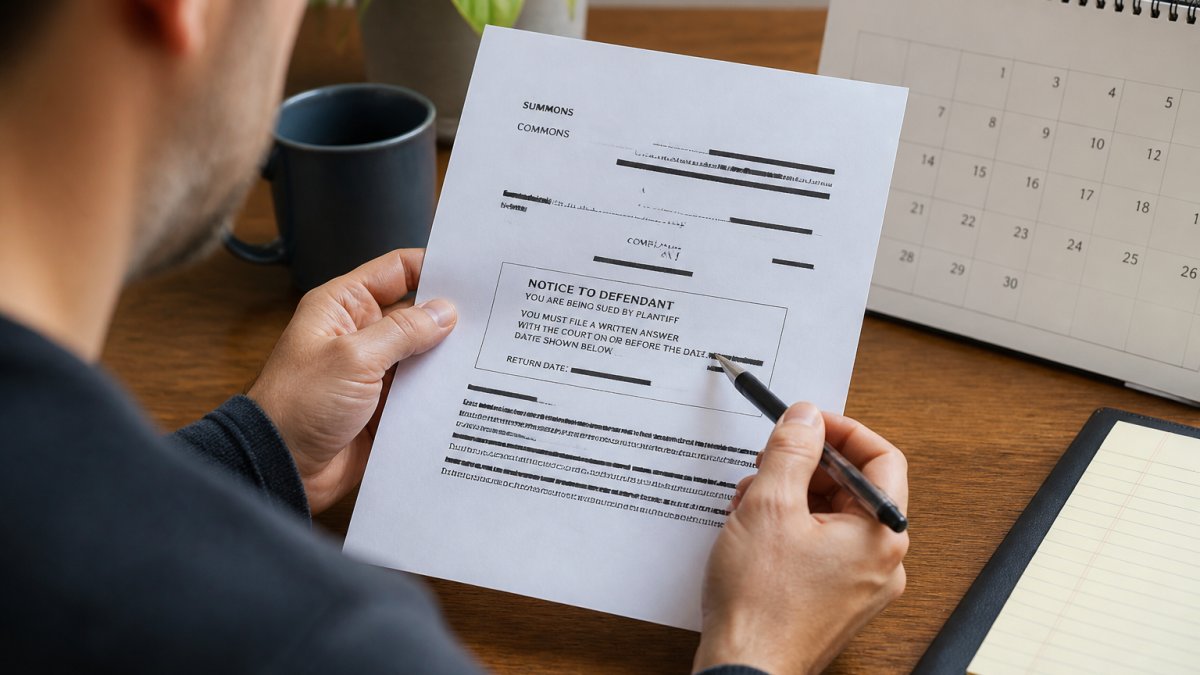
The deadline runs from the date you were served, not the filing date.
Read the entire summons carefully, some courts bury the deadline in legal language. If you can't find it, the court clerk listed on the document can confirm it free of charge.
State-by-State Response Deadline Requirements
Response deadlines are set by each state's rules of civil procedure and the local rules of the court where you were sued, there is no single national deadline. The table below gives the standard answer deadline for state court debt lawsuits in each state, plus the citation to verify it. Federal cases follow a different rule (21 days under FRCP 12(a)(1)(A)(i)).
| State | Standard Deadline to Answer (State Court) | Rule / Citation to Verify |
|---|---|---|
| Alabama | 30 days after service | Ala. R. Civ. P. 12(a) |
| Alaska | 20 days after service | Alaska R. Civ. P. 12(a) |
| Arizona | 20 days after service (30 if served outside state) | Ariz. R. Civ. P. 12(a) |
| Arkansas | 30 days after service | Ark. R. Civ. P. 12(a) |
| California | 30 days after service (35 if served by mail within state) | Cal. Code Civ. Proc. § 412.20 |
| Colorado | 21 days after service (35 if served outside state) | Colo. R. Civ. P. 12(a) |
| Connecticut | 30 days after return date | Conn. P.B. § 10-8 |
| Delaware | 20 days after service | Del. Super. Ct. Civ. R. 12(a) |
| Florida | 20 days after service | Fla. R. Civ. P. 1.140(a) |
| Georgia | 30 days after service | O.C.G.A. § 9-11-12(a) |
| Hawaii | 20 days after service | Haw. R. Civ. P. 12(a) |
| Idaho | 21 days after service | Idaho R. Civ. P. 12(a) |
| Illinois | 30 days after service | 735 ILCS 5/2-602 |
| Indiana | 20 days after service | Ind. Trial R. 6(C) |
| Iowa | 20 days after service | Iowa R. Civ. P. 1.303 |
| Kansas | 21 days after service | Kan. Stat. Ann. § 60-212(a) |
| Kentucky | 20 days after service | Ky. R. Civ. P. 12.01 |
| Louisiana | 15 days after service (30 if served outside state) | La. Code Civ. Proc. art. 1001 |
| Maine | 20 days after service | Me. R. Civ. P. 12(a) |
| Maryland | 30 days after service (60 if served outside state) | Md. R. Civ. P. 2-321 |
| Massachusetts | 20 days after service | Mass. R. Civ. P. 12(a) |
| Michigan | 21 days after service | Mich. Ct. R. 2.108 |
| Minnesota | 21 days after service | Minn. R. Civ. P. 12.01 |
| Mississippi | 30 days after service | Miss. R. Civ. P. 12(a) |
| Missouri | 30 days after service | Mo. R. Civ. P. 55.25 |
| Montana | 21 days after service | Mont. R. Civ. P. 12(a) |
| Nebraska | 30 days after service | Neb. Rev. Stat. § 25-808 |
| Nevada | 21 days after service | Nev. R. Civ. P. 12(a) |
| New Hampshire | 30 days after service | N.H. R. Super. Ct. 27 |
| New Jersey | 35 days after service | N.J. Ct. R. 4:6-1 |
| New Mexico | 30 days after service | N.M. R. Civ. P. 1-012 |
| New York | 20 days after personal service (30 if served other ways) | N.Y. C.P.L.R. § 320(a) |
| North Carolina | 30 days after service | N.C. R. Civ. P. 12(a)(1) |
| North Dakota | 21 days after service | N.D. R. Civ. P. 12(a) |
| Ohio | 28 days after service | Ohio R. Civ. P. 12(A)(1) |
| Oklahoma | 20 days after service | Okla. Stat. tit. 12, § 2012 |
| Oregon | 30 days after service | Or. R. Civ. P. 7(C) |
| Pennsylvania | 20 days after service | Pa. R. Civ. P. 1026 |
| Rhode Island | 20 days after service | R.I. Super. Ct. R. Civ. P. 12(a) |
| South Carolina | 30 days after service | S.C. R. Civ. P. 12(a) |
| South Dakota | 30 days after service | S.D. Codified Laws § 15-6-12(a) |
| Tennessee | 30 days after service | Tenn. R. Civ. P. 12.01 |
| Texas | 20 days after service (Monday after 20 days if served by mail) | Tex. R. Civ. P. 99 |
| Utah | 21 days after service | Utah R. Civ. P. 12(a) |
| Vermont | 21 days after service | Vt. R. Civ. P. 12(a) |
| Virginia | 21 days after service | Va. Sup. Ct. R. 3:8 |
| Washington | 20 days after service (60 if served outside state) | Wash. Super. Ct. Civ. R. 12(a) |
| West Virginia | 20 days after service | W. Va. R. Civ. P. 12(a) |
| Wisconsin | 20 days after service (45 if served outside state) | Wis. Stat. § 802.06(1) |
| Wyoming | 20 days after service | Wyo. R. Civ. P. 12(a) |
How to count the days correctly
The deadline is almost never "the same day next month." Three rules change the math:
- Start counting the day after service. The day you were served is day zero in most states.
- Weekends and court holidays extend the deadline. Under most state rules (and FRCP 6(a)), if the last day falls on a Saturday, Sunday, or legal holiday, the deadline moves to the next day the court is open. Check your state court's holiday schedule.
- Service method can add days. California adds 5 days for in-state mail service; New York gives 30 days instead of 20 when service was not personal; Texas pushes the deadline to the Monday after the 20th day for mail.
Worked example
You live in Ohio. A process server hands you a summons on Tuesday, March 3. Ohio Rule 12(A)(1) gives you 28 days. Day 1 is Wednesday, March 4; day 28 lands on Tuesday, March 31. If March 31 were a Saturday, your deadline would roll to Monday, April 2.
The unique angle: verify, don't assume
The table above is a starting point, not a guarantee. Local rules often shorten or lengthen the standard deadline, and some courts (especially small claims or justice-of-the-peace tracks) use a different clock. Before relying on any number here:
- Read the summons itself, many courts print the actual due date.
- Call the clerk of the court named on the summons to confirm the deadline.
- Check the court's website for local rules and standing orders that change response times.
Federal Rules of Civil Procedure, Rule 12
How to File an Answer to a Debt Lawsuit
Filing an answer is a two-part act: file the original with the court and serve a copy on the debt collector's attorney. Missing either part can still produce a default judgment, even if your answer was perfect.
Step 1: Confirm the deadline and the court
Before writing anything, confirm three things from the summons: the court's full name, the case number, and the exact due date. If no date is stated, call the clerk and ask them to read it from the docket.
Step 2: Draft the answer
An answer responds to each numbered paragraph in the complaint. The three standard responses are:
- Admit, you agree the allegation is true.
- Deny, you disagree, or lack enough information to agree.
- Lack knowledge or information sufficient to form a belief, the standard phrasing when you genuinely don't know. In most states this operates as a denial.
You can also raise affirmative defenses, reasons the collector should lose even if the complaint's facts are true. Common defenses include:
- Statute of limitations (the debt is too old to sue on)
- Lack of standing (the collector does not own the debt)
- Improper service
Step 3: Format it the way your court requires
Most state courts publish a fill-in-the-blank answer form for debt cases, use it if one exists to avoid a formatting rejection. If no form exists, follow your state's rules of civil procedure for caption, numbering, and signature. Include:
- Case caption (court name, case number, parties)
- Numbered responses to each allegation
- Affirmative defenses
- A signature block with your name, address, phone, and email
- A certificate of service showing you mailed a copy to the collector's attorney
Step 4: File with the court
You can usually file in person at the clerk's window, by mail, or through the court's e-filing portal. Fees vary, some courts charge nothing, others a modest fee, and income-based fee waivers are available. Ask the clerk for an "in forma pauperis" fee-waiver form if cost is a barrier.
Step 5: Serve the collector's attorney
Serving means sending a copy of the filed answer to the attorney listed on the complaint. Most courts accept first-class mail; some require certified mail or electronic service. Keep proof, a dated certificate of service, mailing receipt, or e-filing confirmation. If the collector later claims you never answered, this proof is your defense.
The distinction most people miss: answering the lawsuit vs. disputing the debt
These are two separate processes with two separate deadlines, and confusing them is one of the most common ways people lose by default.
- Answering the lawsuit is a court deadline set by the rules of civil procedure and enforced by the judge. Miss it and you can lose automatically.
- Disputing the debt with the collector is a consumer-rights process under the federal Fair Debt Collection Practices Act (FDCPA). If you send a written dispute within 30 days of the collector's initial written contact, the collector must stop collection until it verifies the debt. That 30-day window is not a court deadline and does not replace your answer deadline.
A debt-validation letter does not pause the lawsuit. If you've been served, you must still file an answer by the court's deadline, even if you also send a validation request.
Fair Debt Collection Practices Act, 15 U.S.C. § 1692g (validation of debts)
What Happens If You Don't Respond to a Debt Lawsuit
A default judgment occurs when you fail to file an answer by the deadline.
Once a default judgment is entered:
- The debt collector can garnish your wages
- Bank accounts can be frozen and funds seized
- A lien can be placed on your property
The consequences persist for years. Wage garnishment can take 25% of your disposable income (Fact Sheet #30: Wage Garnishment Protections of the Consumer Credit Protection Act (CCPA)).
You may still have options. Many states allow a motion to vacate a default judgment if you act quickly, usually within 30 days, showing good cause such as a mistake or improper service.
Debt Collection Lawsuit Statute of Limitations by State
The statute of limitations is the deadline for filing a debt collection lawsuit, not for your answer.
Most states have a 3-to-6-year statute of limitations for written contracts like credit card debt. Once it expires, the collector cannot sue you, though they may still try.
The statute of limitations is often shorter than the time a judgment can be enforced, 10 to 20 years in many states, sometimes longer.
Common statute of limitations ranges:
- Credit card debt: 3-6 years (varies by state)
- Medical debt: 3-6 years (varies by state)
- Personal loans: 3-6 years (varies by state)
Using a Debt Lawsuit Answer Template to Protect Your Rights
A debt lawsuit answer template gives you a starting point for your written response. Templates are free from state court websites, legal aid organizations, and online resources, and help ensure you don't miss critical steps.
A basic answer template includes:
- Case caption (court name, case number, parties)
- Numbered responses to each allegation
- Affirmative defenses (statute of limitations, improper service, etc.)
- Signature and date
- Proof of service (showing you served the other side)
Many defendants use templates successfully, but they don't replace legal advice. If the collector's claims are complex or your situation is unusual, consult an attorney.
WageHelpCenter provides guidance on understanding your legal options and helps you locate an affordable attorney before your deadline passes.
What to Do When Your Deadline Is Near or Has Passed
If your response deadline is approaching, act immediately. Confirm the exact deadline with the court clerk, prepare your answer using a template or legal help, and file and serve it before the deadline expires.
If your deadline has already passed, you still have options:
- File a motion to vacate the default judgment (usually within 30 days)
- File a late answer and explain the delay
- Contact the debt collector about settling the case
Acting quickly is critical.
Facing a debt collection lawsuit response deadline can feel overwhelming, but you're not alone. WageHelpCenter provides clear, practical guidance on understanding your rights, identifying your deadline, and taking action before it's too late.
Frequently Asked Questions
How long do I have to respond to a debt collection lawsuit?
The response deadline varies by state and court type. Most states require a response within 20-30 days after being served with the summons and complaint. Some states allow 21 days, while others permit 30 days. Federal courts typically require 21 days under Federal Rules of Civil Procedure. Check your summons carefully for the exact deadline, as missing it can result in a default judgment against you. If you're unsure, contact the court clerk or a local legal aid office for clarification on your state's specific rules.
What happens if I miss the deadline to answer a debt collection lawsuit?
Missing the response deadline can result in a default judgment, meaning the court rules in the creditor's favor without hearing your side. Once a default judgment is entered, the debt collector can pursue wage garnishment, bank account levies, and liens on your property. In some cases, you may file a motion to set aside the default judgment if you have a valid reason for missing the deadline, such as not being properly served. Act quickly if you've missed the deadline, contact a lawyer or legal aid immediately to explore your options.
Can I ask the court for more time to respond to a debt lawsuit?
Yes, you can request an extension by filing a motion for an extension of time to respond. You must file this motion before the original deadline passes. Courts may grant extensions if you have good cause, such as illness, inadequate notice, or difficulty obtaining legal representation. However, extensions are not guaranteed, and the court has discretion to grant or deny your request. Filing the motion shows the court you are engaged in the process and can help protect you from a default judgment if approved.
Does the response deadline depend on how I was served with the lawsuit?
Yes, the response deadline can depend on the method of service and your location. If you're served in person, the deadline typically begins from the date of service. If you're served by mail, some states add extra days (often 3-5 days) to account for delivery time. If you're served outside your home state, different rules may apply. Federal courts and state courts may have different service rules. Always check your summons for the specific service method used and calculate your deadline accordingly. When in doubt, contact your local court clerk for guidance.