 how-to
How to Verify Debt Lawsuit Accuracy: A Step-by-Step Guide
Table of Contents
- Understanding Debt Validation and Your Rights
- Step 1: Understand What Information Collectors Must Provide
- Step 2: Request Verification in Writing Within the 30-Day Window
- Step 3: Identify Common Errors in Debt Collection Lawsuits
- Step 4: Gather Documentation and Evidence for Your Defense
- Step 5: Check Statute of Limitations on Debt by State
- Step 6: Respond to the Summons and File Your Defense
- What Happens If the Debt Collector Fails to Verify
Last Updated: August 18, 2026
Understanding Debt Validation and Your Rights
When a debt collector files a lawsuit against you, you have a powerful legal right most people don't know exists: the right to demand verification of the debt before the case proceeds. This process, called debt validation, requires collectors to prove the debt is actually yours and that the amount is correct. Understanding how to verify debt lawsuit accuracy can mean the difference between a default judgment that haunts your credit for years and a case dismissed because the collector can't back up their claims.
The Fair Debt Collection Practices Act (FDCPA) gives you specific protections. Within 30 days of receiving a summons, you can request that the debt collector provide written verification of the debt. This is a legal requirement, not optional. If they can't verify the debt, the lawsuit should be dismissed. WageHelpCenter provides comprehensive educational resources designed to help individuals navigate the complexities of debt collection lawsuits and wage garnishment, offering clear guidance on legal options, settlements, and default judgments.
Step 1: Understand What Information Collectors Must Provide
When you request verification of the debt, the collector must send you specific documents proving three things: that you actually owe the debt, that they have the right to collect it, and that the amount is correct. Verification is NOT the same as validation. A validation letter is a generic response saying "yes, this debt exists." Verification requires actual proof: your original account, payment history, and how the balance was calculated.
The critical documents you should expect include your original promissory note or credit agreement, a complete payment history showing what you paid and when, the original creditor's account statements, and a detailed breakdown of the current balance including principal, interest, and any collection fees. If the debt has been sold to a debt buyer, they must also provide documentation proving they own the debt and have the legal right to collect it.
Many collectors send vague letters claiming they've "verified" the debt without including any of these documents. This is a red flag. Under the FDCPA, they must provide actual proof, not just assertions.

Step 2: Request Verification in Writing Within the 30-Day Window
The moment you receive a summons, your clock starts. You have 30 days to request verification of the debt in writing. A phone call doesn't count. Send your request via certified mail with return receipt so you have proof of delivery.
Your request must be clear and specific. State that you're requesting verification of the debt under the FDCPA, and specifically ask for itemized account statements, payment history, documentation of the original creditor relationship, and proof that the debt buyer (if applicable) owns the debt. Keep copies of everything: the letter you send, the certified mail receipt, and the return receipt when it comes back.
Using a Debt Validation Letter Template
A debt validation letter is your formal, written request for verification. Here's a template you can adapt to your situation:
[Your Name] [Your Address] [City, State, ZIP] [Your Phone Number]
[Date]
[Debt Collector Name] [Debt Collector Address] [City, State, ZIP]
RE: Debt Validation Request for Account [Account Number]
Dear [Debt Collector Name]:
I am writing to formally request verification of the debt you claim I owe in the amount of $[amount]. This request is made pursuant to the Fair Debt Collection Practices Act, 15 U.S.C. § 1692g(b).
I require that you provide the following documentation within 30 days of receipt of this letter:
- Itemized account statements showing the original creditor's name and account number
- Complete payment history for the account, showing all payments made and dates
- Documentation of how the current balance was calculated, including principal, interest, and any fees
- A copy of the original promissory note or credit agreement
- If the debt has been sold or assigned, documentation proving you own the debt and have the legal right to collect it
- Proof of the original creditor's authorization for you to collect this debt
I dispute the validity of this debt and request that you cease collection efforts until you have provided complete verification. Please provide this information in writing via certified mail.
Sincerely,
[Your Signature] [Your Printed Name]
Send this letter certified mail with return receipt. The collector has 30 days to respond with the documents. If they don't provide complete verification, you have a strong defense against the lawsuit.
Step 3: Identify Common Errors in Debt Collection Lawsuits
Even when collectors provide documents, those documents often contain errors. Your job is to scrutinize every number, every name, and every date. Common errors include incorrect account balances, missing payment credits, and inflated interest charges.
One frequent mistake is when the collector adds collection fees that were never part of the original debt. Look at your original credit agreement, does it mention collection fees? If not, any fees the collector added are potentially unenforceable.
Another common error involves the statute of limitations. Debts have expiration dates. If enough time has passed since your last payment, the debt may be time-barred, meaning the collector cannot legally sue you. Payment history discrepancies are also common, the collector's records might show you didn't make a payment that you actually made, or fail to credit a payment you sent.
Look for missing documentation too. If the collector can't produce the original promissory note or can't show a clear chain of ownership from the original creditor to themselves, that's a red flag.
Step 4: Gather Documentation and Evidence for Your Defense
Your defense is only as strong as your evidence. Start gathering documents immediately after you receive the summons. Collect your bank statements from the time you had the original account. These show what you actually paid and when. Gather any correspondence from the original creditor, statements, letters, and emails. Get copies of any communications you had with the original creditor or debt collector.
Organize everything chronologically. Create a timeline showing when the original account opened, when you made payments, when you stopped paying, and when the debt was sold to the collector. This narrative helps a judge understand what actually happened.
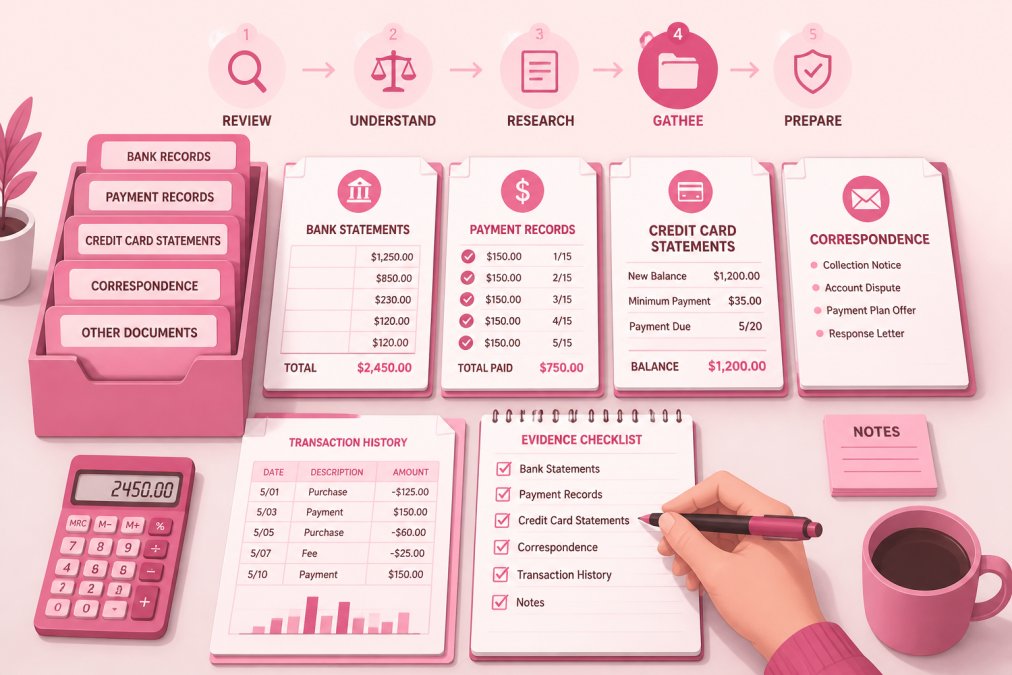
Document any errors you find in the collector's documents. If they claim you owe $5,000 but your records show the original balance was $3,500, note that discrepancy. Build a case file that contradicts their narrative with your actual evidence.
Step 5: Check Statute of Limitations on Debt by State
The statute of limitations is a legal deadline after which a debt collector cannot sue you. This varies dramatically by state and by the type of debt. For credit card debt, most states allow collectors to sue within three to six years of your last payment. The clock starts from your last payment or your last charge to the account, not from when the debt was created. If you made a payment two years ago and your state has a four-year statute of limitations, you still have two years of protection.
Research your specific state's statute of limitations through your state's bar association or legal aid websites. Once you know the limit, calculate when your last payment was and determine if the debt is time-barred. If the debt is time-barred, you still need to raise this as a defense in your response to the summons. The collector won't voluntarily dismiss the case.
Step 6: Respond to the Summons and File Your Defense
Responding to the summons is mandatory. If you don't respond within the time frame specified (usually 20-30 days depending on your state), you'll lose by default. Your response to the summons is called an "answer" in legal terms. It must be filed with the court and served on the collector's attorney.
When you file your answer, include specific defenses related to how to verify debt lawsuit accuracy. State that you requested verification within 30 days and the collector failed to provide complete documentation. List the specific documents they failed to provide. Explain what errors you found in their account statements.
You can file your answer yourself, but court procedures vary by state and by county. Filing deadlines are strict. Consider consulting with an attorney. If you can't afford one, contact your local legal aid office. Many offer free or low-cost representation for debt collection cases. WageHelpCenter can help you locate affordable legal representation in your area.
What Happens If the Debt Collector Fails to Verify
If the collector receives your verification request and fails to provide complete documentation, they've violated the FDCPA. This gives you multiple options, and the strongest one is to raise this violation as a defense in your lawsuit response.
When you file your answer to the summons, include a statement that the collector failed to provide verification despite your timely request. Explain exactly what documents they failed to provide. If they sent you a generic response without itemized statements or payment history, that's not verification, that's a violation. A judge will likely dismiss the case if the collector can't prove the debt exists.
In some cases, the collector's failure to verify gives you grounds for a counterclaim. Under the FDCPA, if a collector violates the law, you can sue them for damages. The most common outcome when a collector fails to verify is case dismissal.
Document everything about the verification process. Keep the certified mail receipt showing you sent the request on time. Keep any response the collector sends. If they miss the 30-day deadline, note that. All of this becomes evidence in your defense.
Facing a debt collection lawsuit is stressful, but you're not defenseless. By understanding how to verify debt lawsuit accuracy and following these steps, you can challenge claims that may be inaccurate or unverifiable. The verification process is your most powerful tool because it requires collectors to prove what they're claiming, and many cannot. Start by requesting verification within 30 days of receiving the summons, gather your documentation, identify errors in their claims, and file a strong response with the court. If the collector fails to verify the debt, you have grounds for dismissal. The Fair Debt Collection Practices Act protects your right to demand this verification, and courts take these violations seriously.
The key is acting quickly and staying organized. Don't ignore the summons, don't miss deadlines, and don't assume the collector's claims are correct just because they're in writing. Every number, every name, and every date is worth scrutinizing. Your financial future depends on it. WageHelpCenter provides comprehensive guides on debt collection lawsuits, wage garnishment, and settlements, resources designed to help you understand your legal options and make informed decisions before a default judgment locks you into years of collection efforts. Get started today by reviewing your summons carefully and preparing your verification request. The 30-day window closes fast.
Frequently Asked Questions
How do I know if a debt collection lawsuit is real?
A legitimate debt collection lawsuit includes a summons and complaint filed with your local court. Check the court's website using the case number listed on the summons to verify the filing. Real lawsuits come with official court seals and the plaintiff's attorney information. Be cautious of any communication that doesn't include a court case number or that pressures you to pay immediately without legal process. Contact your county courthouse directly if you're unsure about legitimacy.
What should I look for when verifying debt lawsuit accuracy?
Examine the account number, balance, payment history, and original creditor information listed in the complaint. Cross-reference these details against your own records. Look for discrepancies in dates, amounts owed, or interest charges. Verify whether the statute of limitations on debt by state has passed, many states have 3-6 year limits depending on the debt type. Request itemized account statements from the debt collector to confirm the exact amount claimed. If anything doesn't match your records, document the discrepancies for your defense.
Can a debt collector sue me for a debt I don't owe?
Yes, debt collectors can file lawsuits for debts you don't owe, either due to identity theft, error, or time-barred debt. This is why verifying the debt is critical. You have the right to dispute the claim in court. If the debt is time-barred under your state's statute of limitations, you can raise this as a legal defense. Request verification of the original creditor and account details. If the collector cannot prove you owe the debt, the court may dismiss the case. Respond to the summons rather than ignoring it, a default judgment can lead to wage garnishment.
What happens if I ignore a debt collection lawsuit?
Ignoring a debt collection lawsuit typically results in a default judgment against you. This means the court rules in the creditor's favor without hearing your side. A default judgment can lead to wage garnishment, bank levies, and damage to your credit score for seven years. Once a judgment is entered, it becomes much harder to challenge the debt's validity. You must respond to the summons within the timeframe specified (usually 20-30 days) to preserve your right to defend yourself in court and verify the debt's accuracy.
This article was written using GrandRanker