 how-to
How to File a Claim of Exemption: Step-by-Step Guide
Table of Contents
- What Is a Claim of Exemption?
- Understanding Wage Garnishment Exemption Limits
- Step 1: Gather Your Financial Information and Documentation
- Step 2: Complete the Claim of Exemption Form Template
- Step 3: File Your Claim and Serve the Judgment Creditor
- How Long Does a Claim of Exemption Take to Process?
- Common Mistakes That Lead to Rejection
- What Happens at a Court Hearing on Your Claim of Exemption
Last Updated: August 7, 2026
What Is a Claim of Exemption?
A claim of exemption is a legal document you file with the court to protect your wages, bank account, or personal property from being seized to pay a debt judgment. When a creditor wins a lawsuit against you, they obtain a judgment that gives them the legal right to collect money directly from your income or assets. A claim of exemption stops or limits that collection process by designating which of your earnings and assets are protected under state and federal law.
Think of it as a formal objection to wage garnishment. You're telling the court: "These funds are exempt from collection under the law, and here's why." If approved, the creditor cannot touch the protected income or assets. This protection exists because lawmakers recognize that people need a minimum level of income and property to survive. Federal law and every state's laws carve out certain assets and earnings as "exempt" from creditor claims.
WageHelpCenter helps individuals understand their exemption rights and guides them through the filing process so they can protect what they're legally entitled to keep.
Understanding Wage Garnishment Exemption Limits
Federal law limits wage garnishment to the lesser of two amounts: 25% of your disposable earnings, or the amount by which your weekly earnings exceed 30 times the federal minimum wage. Disposable earnings are what's left after legally required deductions like income taxes, Social Security, and unemployment insurance. However, many states have enacted their own exemption laws that provide even greater protection, some protect 75% or more of your earnings, and a few prohibit wage garnishment entirely for consumer debts.
Exempt property extends beyond wages. Certain assets are protected regardless of the debt amount, typically including your primary residence (up to a certain equity value), a vehicle, household furnishings, tools of your trade, and retirement accounts like 401(k)s and IRAs. The specific dollar limits and categories vary by state. Some states use a "wildcard" exemption that lets you protect additional property of your choosing up to a certain dollar amount.
The key mistake people make is assuming federal protections are enough. Your state law likely offers better protection, and you need to claim it correctly in your exemption filing.
Step 1: Gather Your Financial Information and Documentation
Before you complete the claim of exemption form, assemble detailed financial information about your income, assets, and living expenses. The court needs to see that you qualify for the exemptions you're claiming.
Start by collecting recent pay stubs, ideally the last three months, to calculate your average weekly or monthly disposable earnings. Next, list your assets and their values: bank account balances, vehicle information and estimated value, retirement account statements, property deeds, and any other significant assets. Be honest about values; the court can verify this information, and inflating asset values is considered fraud.
Document your essential living expenses: rent or mortgage, utilities, food, insurance, childcare, medical costs, and transportation. Gather any court documents you've received, including the summons, judgment, and any notice of garnishment or levy. These contain critical information: the case number, the judgment creditor's name, the judgment amount, and the effective date of any garnishment.

If you're claiming an exemption for your primary residence, gather the deed and information about your home's current market value and any mortgages or liens against it. For vehicles, get the title and a realistic estimate of current value. For retirement accounts, gather statements showing the account type and balance. Keep copies of everything you submit.
Step 2: Complete the Claim of Exemption Form Template
The claim of exemption form is a standardized document, but the exact form varies by state and sometimes by county. Your state court's website typically provides the official form, or contact the court clerk's office to request it. Using the correct form for your jurisdiction is non-negotiable; courts reject forms that don't match their local requirements.
The form typically asks for identifying information: your name, address, the case number, the judgment creditor's name, and the court where the judgment was entered. Accuracy here is critical because any mismatch can cause your claim to be rejected or delayed.
Next, you'll list the specific income or assets you're claiming as exempt. For wage garnishment claims, you'll state that your earnings are exempt under federal law, your state law, or both, specifying the amount of your weekly or monthly disposable earnings and explaining why it qualifies for protection. For asset exemptions, list each asset separately with its description, estimated value, and the specific statute that provides the protection.
Many forms ask you to explain why the income or assets qualify for exemption. Keep explanations clear and factual. Some states require you to sign the form under penalty of perjury, meaning you're swearing that the information is true and accurate. False statements can result in perjury charges in addition to the claim being denied.
Before submitting, review the form three times to ensure all case numbers match, all names are spelled correctly, and all information is accurate.
Step 3: File Your Claim and Serve the Judgment Creditor
Filing your claim of exemption involves two separate steps: filing the document with the court and serving a copy on the judgment creditor (or their attorney). Both steps are legally required and must be completed correctly and within the deadline.
Most states require you to file a claim of exemption within 10 to 30 days of receiving notice of the garnishment or levy. If you miss the deadline, you typically lose the right to claim the exemption. File the completed form with the court that issued the judgment, usually the trial court in the county where the lawsuit was filed. Include the original and any required copies. Many courts now accept electronic filing through their online portal. If filing by mail, use certified mail with return receipt so you have proof of delivery. The filing fee varies by state and county, typically ranging from zero to fifty dollars, though some courts waive fees for people with low incomes.
After filing with the court, you must serve a copy of your claim on the judgment creditor or their attorney. Valid service methods typically include personal delivery, certified mail with return receipt requested, service by a professional process server, or electronic service if the creditor has agreed to accept documents electronically.
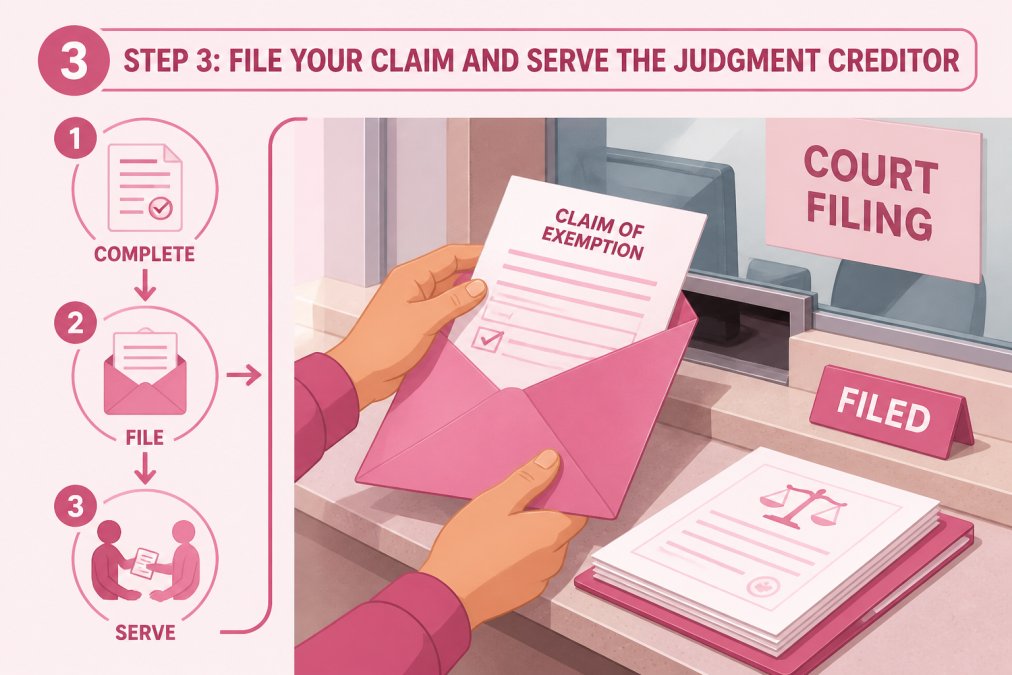
Keep proof of service and file it with the court, usually within 5 to 10 days after service. This completes the filing process. Keep copies of everything: the original claim, the filed-stamped copy from the court, proof of service, and the court's file-stamped proof of service document.
How Long Does a Claim of Exemption Take to Process?
After you file and serve your claim, the judgment creditor has a set period to respond, typically 10 to 30 days, depending on your state. If they don't respond, the court may grant your claim by default. If the creditor opposes your claim, the court will schedule a hearing. The timeframe varies widely, some courts schedule hearings within 2 to 4 weeks, while busy urban courts may take 6 to 12 weeks.
The hearing itself usually lasts 15 to 30 minutes unless complex issues are involved. You'll have the opportunity to present evidence and explain why your income or assets qualify for exemption. The creditor will argue against your claim, and the judge will decide whether your exemption is valid.
After the hearing, the judge issues a ruling. Some judges rule from the bench immediately; others issue a written decision days or weeks later. Once a ruling is issued, either party may have a limited time to appeal (typically 10 to 30 days).
If your claim is granted, the garnishment stops or is modified to comply with the exemption. If denied, the garnishment continues as originally ordered, though you may have the right to appeal. The entire process, from filing to final ruling, typically takes 2 to 4 months in straightforward cases. WageHelpCenter emphasizes the importance of acting quickly once you receive notice of garnishment. The sooner you file your claim of exemption, the sooner the court can resolve the issue and protect your income.
Common Mistakes That Lead to Rejection
The most frequent mistake is missing the filing deadline. If you receive notice of garnishment and wait more than 30 days (or your state's deadline) to file a claim of exemption, you typically lose the right to claim the exemption. Always file as soon as possible after receiving notice.
Using the wrong form is another common rejection reason. Courts have specific forms for claims of exemption, and they often differ from forms used in neighboring states or from generic templates found online. Contact your court clerk or check the court's website to get the correct form.
Failing to serve the judgment creditor properly or not filing proof of service with the court within the required timeframe causes many claims to be dismissed. Claiming exemptions that don't exist under your state's law results in automatic rejection. Research your specific state's exemption laws before filing.
Providing incomplete or inaccurate financial information undermines your claim's credibility. If you claim your wages are exempt because they fall below the garnishment threshold but your pay stubs show otherwise, the court will deny your claim. Be thorough and honest in documenting your income and assets.
Failing to appear at the hearing or appearing unprepared is a practical mistake that leads to denial. If the creditor opposes your claim, you must attend the hearing and be ready to answer questions about your income, assets, and living expenses. Bring your documentation with you.
What Happens at a Court Hearing on Your Claim of Exemption
If the judgment creditor opposes your claim of exemption, the court will schedule a hearing. The hearing is your opportunity to convince the judge that your exemption claim is legally valid.
You'll be sworn in to tell the truth. The judge may ask you questions directly, or the creditor's attorney may ask questions first. Be prepared to discuss your income, assets, living expenses, and the specific basis for your exemption claim. Bring all your documentation: recent pay stubs, bank statements, asset valuations, proof of living expenses, and the original court documents from your case.
You don't need an attorney to appear at the hearing, though having one helps. If you can't afford an attorney, many legal aid organizations offer free or low-cost representation for people facing wage garnishment. If you represent yourself, speak clearly and directly, answer the judge's questions concisely, and stick to facts. Focus on whether your income or assets meet the legal exemption criteria under your state's law.
After hearing both sides, the judge will either rule immediately or take time to issue a written decision. If a written decision is issued later, the court will mail it to you. The ruling will specify whether your exemption claim is granted or denied and explain the judge's reasoning.
If you're facing wage garnishment and need guidance on protecting your income and assets, WageHelpCenter provides comprehensive resources on exemption laws, claim filing procedures, and your legal options. The platform helps you understand your state's specific protections and connects you with affordable legal assistance when you need professional guidance. Don't wait until garnishment becomes a crisis; understanding your exemption rights now allows you to act quickly and protect what the law allows you to keep.
| Step | Deadline | Key Action | Common Error |
|---|---|---|---|
| Gather financial documents | Before filing | Collect pay stubs, asset valuations, expense records | Incomplete or inaccurate documentation |
| Complete exemption form | Within 10-30 days of notice | Use your state's official form, list protected income/assets | Using wrong form or claiming invalid exemptions |
| File with court | Within deadline | Submit original and copies, pay filing fee | Missing deadline or filing with wrong court |
| Serve judgment creditor | Within deadline | Use proper service method, file proof of service | Improper service or no proof of service |
| Attend hearing (if opposed) | As scheduled by court | Present documentation, answer judge's questions | Not appearing or appearing unprepared |
| Receive ruling | After hearing | Review judge's decision and next steps | Failing to appeal if decision is unfavorable |
Frequently Asked Questions
What is a claim of exemption and why do I need to file one?
A claim of exemption is a legal document you file with the court to protect certain income and property from wage garnishment. When a judgment creditor wins a lawsuit against you, they can attempt to collect through wage garnishment, deducting money directly from your paycheck. By filing a claim of exemption, you assert that your income qualifies for legal protection under federal or state exemption laws. This is your primary defense against wage garnishment and must be filed within the deadline specified in your notice of right to claim exemption, typically 10-30 days depending on your state.
What are wage garnishment exemption limits, and how do I know what I can protect?
Wage garnishment exemption limits vary by state and income type. Federal law protects 75% of your disposable earnings (after taxes and mandatory deductions) or 30 times the federal minimum wage, whichever is greater. Many states offer additional protections for certain income sources like Social Security, disability benefits, unemployment insurance, and child support. Some states also protect a percentage of earnings for low-income workers or those experiencing financial hardship. Check your state's specific exemption laws or consult a legal aid organization to determine which of your income and property qualifies for protection. Exempt property typically includes primary residences (up to a certain equity amount), personal vehicles, essential household items, and retirement accounts.
How long does a claim of exemption take to process after I file it?
Processing time varies by state and court, but typically ranges from 30 to 60 days. After you file your claim of exemption with the court clerk and serve the judgment creditor, the creditor has a limited time (usually 10-30 days) to object or request a court hearing. If they do not object, your exemption may be granted without a hearing. If they object, the court will schedule a hearing where you can present evidence of your financial hardship and why your income qualifies for exemption. During this waiting period, wage garnishment may be temporarily halted or reduced, depending on your state's rules. Contact your court clerk or local legal aid office for specific timelines in your jurisdiction.
Do I need a lawyer to file a claim of exemption?
You do not legally need a lawyer to file a claim of exemption, you can file pro se (representing yourself). The form itself is relatively straightforward and available from your court clerk or your state's court website. However, if your financial situation is complex, your state has strict deadlines, or you face an aggressive creditor, consulting with a legal aid attorney or affordable legal service can strengthen your case. Many legal aid organizations offer free or low-cost consultations. If you cannot afford an attorney, ask the court about fee waivers or payment plans. WageHelpCenter provides educational guides to help you understand the process and your options before deciding whether professional representation is necessary for your specific situation.
This article was written using GrandRanker